The episode involving Paul Volcker — chairman of the Federal Reserve from 1979 to 1987 — was recounted by Dr. Alma True Ott in an interview with Lynette Zang, available on YouTube. However, beyond its narrative and evocative value, this story presents several elements of inconsistency, both methodologically and economically and symbolically. For this very reason, it lends itself to critical analysis, aimed not so much at polemical refutation as at assessing its internal coherence, historical plausibility, and discursive function within the context in which it is being retold today.
The video in question currently represents the only available source for this episode.
According to Ott, after training in accounting in the 1980s, he took part in a restricted training program held at a Marriott Group hotel near Wall Street, to which he was admitted thanks to a scholarship he had obtained himself. The initiative reportedly involved about twenty selected participants, all of them of Jewish faith, with the exception of himself, who identifies as a Mormon. Ott nevertheless specifies that he had no problem with the religious affiliation of the other participants; on the contrary, he states that he shared a room with a Jewish person with whom he claims he always got along very well.
According to Ott, after training in accounting in the 1980s, he attended a training event at the Marriott — to which he was admitted thanks to a scholarship he himself obtained — composed of about twenty selected people, all of Jewish faith (he was an exception, being a Mormon). Ott, however, clarifies that he had no problem with the fact that they were Jewish; in fact, he claims to have had a Jewish roommate with whom he claims he always got along well.
The event, according to his version, was attended by prominent figures from the financial world, including Paul Exter, former chairman of Citibank, and top executives from Goldman Sachs. This is where Volcker, who intervened unexpectedly, would have distributed laminated cards with direct phone numbers of the world’s main mints, then lit a cigar, and used it to burn a $100,000 bill with the image of Woodrow Wilson. He explained that this type of money was intended for the “goyim,” while implying that for the elite, the real currency would be something else.
Here it is appropriate to dwell on the term goy. In Hebrew it is written גוי (goy , plural גויים – goyim) and its literal meaning is simply “people” or “nation”. In the Hebrew Bible it is used in a neutral sense to indicate any people, sometimes including the Jewish people themselves. In modern usage, especially colloquial, goy indicates a non-Jewish person, and is essentially equivalent to the term “gentile” in Christian traditions. In itself, it is not necessarily a derogatory term, but its semantic value depends heavily on the context and the communicative intention. In Ott’s story, however, the term is inserted into a highly symbolic narrative, where the “goy money” is contrasted with the “real money” reserved for a select group, and this contributes to constructing an implicit distinction between an “inside” and an “outside”, between the initiated and the profane.
To complete the picture, Volcker allegedly added the claim that the $100,000 bill would one day be worth the same as a dollar bill, accompanied by an explicit invitation to invest exclusively in gold. When Ott asked him about the advisability of not putting all his eggs in one basket — and thus diversifying his risk — Volcker responded by rattling some gold coins he held in his hand, observing that those were not “eggs” that should be placed in any basket. The implicit message of the story is that, if these words were truly uttered by the world’s most powerful central banker, they would constitute a definitive revelation about the true nature of money.
🕵️ Problems and inconsistencies in the story
🔍 Third-party sources are missing
The first methodological problem with this narrative is its complete lack of verifiability. No names of other participants are provided, no precise locations are indicated, nor are any dates associated with specific events. The sole source is Alma True Ott’s autobiographical account, uncorroborated by documents, independent testimonies, or archival evidence. In historiographical and journalistic terms, this is a single, oral, unverifiable source: an extremely fragile basis on which to build general conclusions, especially when the content of the testimony claims to have systemic and almost revelatory significance.
⛔ Potentially discriminatory
Added to this is a second criticality, more subtle but no less relevant: the symbolic structure of the story. The marked distinction between “Jews” and “goyim”, the idea of a small room composed of initiates, the use of language that implicitly suggests the existence of an elite possessing secret knowledge of money, they construct a narrative framework that easily lends itself to discriminatory interpretations. Even if the story doesn’t make explicit accusations, the overall risk lies in the evocation of a division between a privileged “us” and an external “them,” where the identity category is charged with an economic and symbolic meaning that goes far beyond its original linguistic meaning.
📉 Financially inconsistent
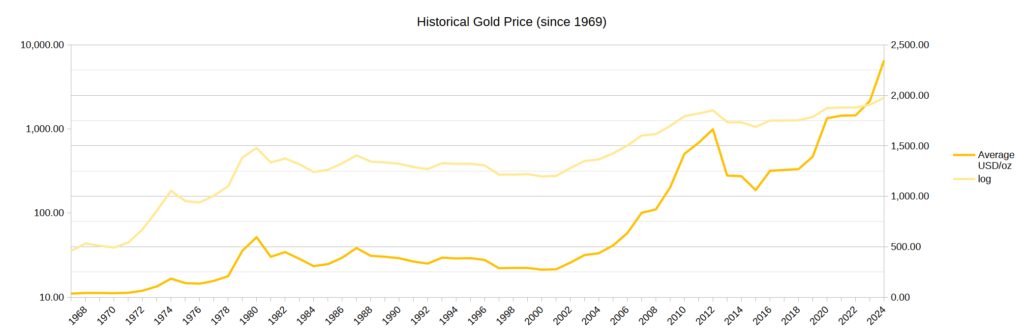
The key issue, however, is not only cultural or symbolic, but also economic. If we try to chronologically situate the episode, significant inconsistencies emerge. According to information provided by Ott himself, the meeting with Volcker most likely occurred in 1984, the same period in which he claims to have worked on Wall Street. At that very time, the price of gold averaged around $330 an ounce and would have experienced a long period of stagnation, returning to those levels only in the early 2000s, approximately around 2002.
From 1984 to about 2002, the price of gold did not increase; instead, it fell.
In concrete terms, an investment in gold during those years would have resulted in stagnation, if not actual losses, for nearly 20 years. It’s difficult to reconcile this historical fact with the idea that the world’s most powerful central banker was providing a select group of “initiates” with a foolproof strategy for preserving and growing wealth. If Volcker truly had insider knowledge of the future of the monetary system, it seems unlikely that he would have recommended an asset that, in fact, would underperform for nearly two decades, while the US stock markets were entering a phase of strong expansion in those very years.
📌 Final considerations
This gap between narrative and historical data introduces an element of critical rationality: the story works well as a myth, much less so as an economic analysis. The figure of the “great banker” who reveals the hidden truth, the theatrical gesture of the burning banknote, the metallic sound of the gold coins, all reinforce the emotional impact of the story, but do not increase its factual solidity. Indeed, they contribute to shifting the focus from the level of empirical verification to that of symbolic suggestion.
When this type of narrative is then picked up and amplified within media and editorial circles focused on the topic of gold as a safe haven, the risk is primarily one of interpretation. On the one hand, there is a tendency to oversimplify the complexity of monetary phenomena, reducing them to a contrast between “counterfeit money” and “real money.” On the other, it constructs an imaginary in which economic knowledge takes the form of a revelation reserved for a select few, rather than a historical, institutional, and collective process.
In this sense, the issue is not so much whether Volcker actually uttered those words — which, at present, cannot be verified — but rather the function this story serves today. More than a historical testimony, it appears as a narrative device: a story that serves to legitimize a vision of money as an illusion, of gold as the only tangible reality, and of elites as the custodians of special knowledge. Its value is therefore primarily symbolic and rhetorical, not cognitive.
Ultimately, the greatest risk is not that the story is false, but that it will be taken as true precisely because it satisfies a widespread need for simple, personalized, and dramatic explanations in a field — monetary and financial — that is structurally complex and resistant to spectacular revelations. In this sense, Ott’s story seems to me to belong not to the realm of economic history, but to that of contemporary financial myths.










Lascia un commento